• Skip to primary navigation
  • Skip to main content
  • Skip to primary sidebar

North Atlanta, GA

  • Home
  • Find Local Food
  • Meetings
  • Farm Tours
  • Recipes

Archives for April 2024

Sauerkraut from Nourishing Traditions

April 22, 2024 by northatlantaga 1 Comment

This is the recipe we followed at our April 2024 Meeting about fermented vegetables.

Makes 1 quart

  • 1 quart-sized wide-mouth mason jar with lid and band
  • 1 medium cabbage, cored and shredded (reserve one large leaf to use as a the top layer)
  • 1 tablespoon caraway seeds
  • 1 tablespoon sea salt
  • 4 tablespoons whey (if not available, use an additional 1 tablespoon of salt)

In a bowl, mix shredded cabbage with caraway seeds, sea salt and whey. Pound with a wooden pounder or meat hammer for about 10 minutes to release juices. Place in a quart-sized, wide-mouth mason jar and press down firmly with a pounder or meat hammer until juices come to the top of the cabbage. The top of the cabbage should be at least 1 inch below the top of the jar. Stuff the large cabbage leaf you saved into the top of the jar to keep everything else below the bring. Cover loosely with canning lid and keep at room temperature for about 3 days before transferring to the refrigerator. The sauerkraut may be eaten immediately, but it improves with age.

Optional Additions:

Add any combination of shredded carrot, mustard seeds, dill, garlic powder, etc. to add new and interesting flavors to your sauerkraut.

Filed Under: Recipes

April 2024 Meeting

April 10, 2024 by northatlantaga 2 Comments

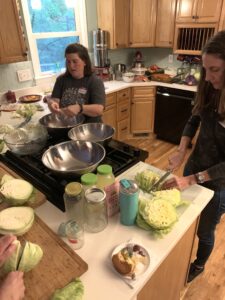
At our April meeting we started with a quick tour of Sandra’s garden. Back inside, we talked about the history and benefits of lacto-fermented food. We sampled a variety of fermented vegetable. Then everyone made their own jar of sauerkraut to take home. Here is the recipe we followed:
Sauerkraut from Nourishing Traditions

In a recent Wise Traditions Podcast they also talked about gut health and the importance of using whole food probiotics for overall health.
Wise Traditions Podcast Episode #471
Address Gut Distress with Dr. Loredana Shapson

Sandra’s notes from her presentation on Fermented Foods:

I’m sure you have all heard of Probiotics.

  • Today, most of us have heard we are supposed to get plenty of probiotics after a round of antibiotics to get things
  • When you’re done with your antibiotics then you can stop with the probiotics and everything goes back to normal. Right? WRONG!

Our culture is terrified of germs and obsessed with hygiene

  • chlorinated water
  • antibacterial soap
  • hand sanitizer
  • worst of all: we pasteurize and sterilize our food – if the lid doesn’t pop we don’t eat it.

What did humans do before all of this life-saving food technology?

  • Canning was only invented in 1810
  • 1812 the first U.S. canning facility for oysters, meats, fruits and vegetables opened in New York
  • Mass production of modern refrigerators didn’t get started until after World War II (1946)
  • 1955 80% of American homes now have refrigerators

Fruits and vegetables don’t grow all year long. The farther away you get from the equator the shorter your growing season. You have to have some way to preserve food for the winter time.

For thousands of years humans have used a process called lacto-fermentation to preserve food.

Every culture around the world has some form of traditional fermented food.

Cabbage most common

  • In China, records date that cabbage has been fermented for over 6,000 years.
  • historical Roman texts, sauerkraut was prized for its delicious taste and medicinal properties.
  • British explorer, Captain James Cook, forced his crew to eat sauerkraut (1768 to 1780).
  • Russia and Poland use pickled green tomatoes, peppers and lettuces.
  • Korean kimchi, for example, is a lacto-fermented condiment of cabbage with other vegetables and seasonings and is eaten daily.
  • In Japan, it’s not a complete meal without miso, soy sauce and pickles.
  • India soured milk is consumed at practically every meal.
  • Africa porridge of fermented millet, corn, cassava, and sorghum are daily staples.
  • Muslim countries – fermented-grain breads and milk products.
  • Early American tradition includes many types of relishes, developed primarily to mask the taste and odor of less than fresh food. In India, varieties of chutneys, all of which were originally lacto-fermented products, are traditional foods.

Only recently have canning and freezing emerged as alternative methods of long term food preservation. They are convenient in some respects, but nutritionally speaking, they are a step backwards from fermentation.

Pasteurization and canning are the opposite of Lacto-fermentation

In Fermentation you are setting up a proper environment to encouraging the growth of beneficial bacteria, mostly lactobacillus.

  • Lactobacillus feed on the sugars present in foods to create lactic acid that suppresses the toxin producing bacteria – preserving the food.
  • Microorganisms in the fermentation process also produce vitamins, enzymes, antioxidants, beta-glucans, and phytonutrients.

We nourish ourselves not by what we eat but by what we are capable of breaking down and transforming into nutrients the body can use.

The digestive process has two distinct features:

  • one is the breaking down of ingested foods;
  • the other is the building up of nutrients needed by the body.

If the breaking down is incomplete, the building up cannot proceed correctly.

Lactic acid contributes to both processes – that of decomposition and that of reconstruction.

  • LA Supplies digestive juices in the form of organic acids that help break down the foods we eat,
  • Activates the metabolic processes whereby these foods are transformed into new living substances.

Lactic acid normalize the acidity of the stomach.

  • If stomach acidity is insufficient, it stimulates the acid producing glands of the stomach
  • In cases where acidity is too high it has the inverse effect.

Lactic acid helps break down proteins and thus aids in their assimilation of iron.

  • The decomposition in the stomach of the organic forms of iron depends on the quantity of hydrochloric acid present as well as the amount of vitamin C

Lactic acid activates the secretions of the pancreas, which is particularly important for diabetics

A 1999 study published in the Lancet found that consumption of lacto-fermented vegetables was positively associated with low rates of asthma, skin problems and autoimmune disorders in Swedish children attending a Waldorf school. The same study found that use of raw milk and avoidance of vaccinations added to the protective effects.

VEGGIES

ANY vegetable can be fermented. Feel free to experiment!

Today we are making Sauerkraut from Nourishing Traditions: In addition to all the benefits of lactic acid, sauerkraut contains large quantities of choline

  • lowers blood pressure and regulates the passage of nutrients into the blood
  • aids the body in the metabolism of fats. If choline is lacking, fats accumulate in the liver

Sauerkraut also contains acetylcholine which has a powerful effect on the parasympathetic nervous system.

  • helps reduce blood pressure
  • slows down the rate of heartbeat
  • promotes calmness and sleep.
  • beneficial effect on the peristaltic movements of the intestine. Sauerkraut and other lacto-fermented vegetables thus are recommended for constipation.

According to a Finnish study, published in the Journal of Agricultural and Food Chemistry, fermentation breaks down glucosinolates in cabbage into compounds called isothiocyanates, which are already known to fight cancer. We are finding that fermented cabbage could be healthier than raw or cooked cabbage,” says one of the paper’s authors.

DRINKS

Beet Kvass is valuable for its medicinal qualities and as a digestive aid.

We talked about beets and beet Kvass at our last meeting: March 2024 Meeting

One glass morning and night

  • is an excellent blood tonic,
  • promotes regularity,
  • aids digestion,
  • alkalizes the blood,
  • cleanses the liver and is a
  • good treatment for kidney stones and other ailments.

Beet kvass may also be used in place of vinegar in salad dressings and as an addition to soups.

Kombucha

  • Mother, mushroom, SCOBY
  • Said to help controll excess Candida.
  • May contain probiotic strain S. Boulardii

DAIRY

Yogurt, Kefir, Cultured Butter
Before the age of industrialization, milk was consumed as yogurt, cheese, clabber, or curds and whey.
Without pasteurization or refrigeration, milk sours and separates spontaneously.

This is due to the process of lacto-fermentation

  • lactic-acid-producing bacteria begin digesting or breaking down both milk sugar (lactose) and milk protein (casein).

When these friendly bacteria have produced enough lactic acid to inactivate all putrefying bacteria, the milk is preserved from spoilage for several days or weeks. In the case of cheese, for years.

Research has shown that regular consumption of cultured dairy products lowers cholesterol and protects against bone loss.

Both vitamin B and vitamin C content of milk increase during fermentation.

Fermentation also breaks down casein, or milk protein, one of the most difficult proteins to digest.

Culturing restores many of the enzymes destroyed during pasteurization including lactase, which helps the body absorb calcium and other minerals. People who are lactose intolerant can often enjoy cultured dairy products without problems.

GRAINS & SEEDS

While lactic acid fermentation does not usually increase the level of minerals present in fermented foods it does decrease the activity of phytic acid content naturally present in grains.

In the past we ate most of our grains in partially germinated form.

  • Grain standing in sacks in open fields often began to sprout before it was brought into storage.
  • Modern farming techniques prevent grains from germinating before they reach our table.

The process of germination

  • produces Vitamin C
  • increases vitamin B content, especially B2, B5 and B6.
  • Carotene increases dramatically – sometimes 8 fold.
  • neutralizes enzyme inhibitors present in all seeds. These inhibitors can neutralize our own precious enzymes in the digestive tract.

The end result is that you get more bang for your nutritional buck by sprouting or souring the grains & seeds you eat.

Many processed foods available today began as fermented foods, such as ketchup and soft drinks.

Filed Under: Past Meetings

Primary Sidebar

Archives

  • March 2026
  • January 2026
  • December 2025
  • November 2025
  • October 2025
  • September 2025
  • August 2025
  • July 2025
  • June 2025
  • May 2025
  • April 2025
  • March 2025
  • February 2025
  • January 2025
  • November 2024
  • October 2024
  • September 2024
  • August 2024
  • July 2024
  • June 2024
  • May 2024
  • April 2024
  • March 2024
  • February 2024
  • January 2024

External Links


Weston A. Price Foundation

Legal Defense Fund