• Skip to primary navigation
  • Skip to main content
  • Skip to primary sidebar

North Atlanta, GA

  • Home
  • Find Local Food
  • Meetings
  • Farm Tours
  • Recipes

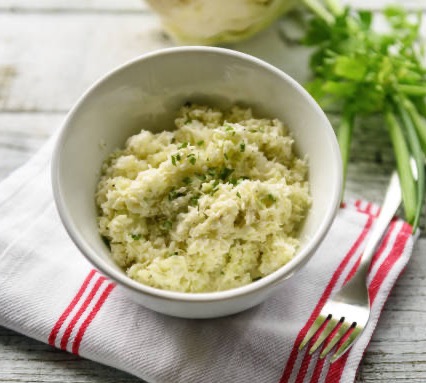
Mashed Kohlrabi with Roasted Garlic

July 31, 2024 by northatlantaga Leave a Comment

This recipe was featured at our July 2024 meeting.

from The Rustic Foodie®
https://www.therusticfoodie.com/wprm_print/mashed-kohlrabi-with-roasted-garlic

Ingredients

  • 2 large Kohlrabi
  • 1 bulb Garlic
  • Olive Oil
  • ⅓ cup Heavy Whipping Cream
  • ¾ tsp. Kosher Salt (split)
  • ½ tsp. Pepper

Instructions

Peel and Cut The Kohlrabi:

  • Remove the stems and leaves from the kohlrabi. The leaves may be used in another recipe, or discarded in the compost bin or trash. Pull any fibrous shoots from the surface of the kohlrabi bulb off with your fingers and discard.
  • Cut the top and bottom of the kohlrabi off with a knife, creating a flat surface on both the top and bottom.
  • Placing one of the flat surfaces on a cutting board, remove the outer skin of the kohlrabi, cutting from the top to the bottom with the knife. Discard the tough outer skins. Continue until all of the skin has been removed from the kohlrabi.
  • Cut the peeled kohlrabi bulb in half. Placing the flat surface on a cutting board, cut it in half again, and then into chunks, just as you would a potato. Repeat with the other half of the kohlrabi.
  • Repeat the process with the second kohlrabi. Make sure that the chunks are relatively even in size to ensure that they cook evenly.Yields 6-8 cups chopped kohlrabi.

Roast The Garlic:

  • Heat oven to 400 degrees Fahrenheit.
  • Cut the top off a head of garlic, remove any loose outer skins from the garlic, and discard.
  • Place the head of garlic on a small square of tinfoil and drizzle a small amount of olive oil over the top of it. Loosely wrap the garlic in the foil, place on a small baking sheet, and pop it in the oven.
  • Roast the garlic for 35 minutes. Remove from oven and allow to cool.

Boil The Kohlrabi:

  • Place the peeled kohlrabi chunks in a large pot and fill with cold water. Add ¼ tsp. kosher salt to the water.
  • Place the pot on the stove top and bring to a boil. Once boiling, reduce to a low boil and cook, uncovered, for 25-30 minutes, or until the kohlrabi is fork-tender.
  • Once the kohlrabi is fork tender (but not mushy), place it in a colander and allow to drain completely.Cooking times may vary, depending on the size of the kohlrabi chunks. It should be easily pierced with a fork, but not mushy, when finished.

Mash The Kohlrabi:

  • Add the drained kohlrabi back into the pot, place on the stove top, and turn the heat to low.
  • Add 4 cloves of the roasted garlic (or as many as you like) to the pot, along with ⅓ cup heavy whipping cream and ½ tsp. each kosher salt and pepper.
  • Mash the kohlrabi with a potato masher (this will result in a chunkier texture). Kohlrabi is slightly tougher than potatoes and will likely still be chunky if using a potato masher.
  • If you prefer a creamier texture, puree the kohlrabi with an immersion blender. Place the blender in the pot (remove from stove top and turn off heat) and puree on medium speed until the kohlrabi is smooth and creamy.
  • To Serve: Garnish with fresh herbs if desired.

Notes

It’s best to choose kohlrabi that is not too large or old, as it becomes tougher the older it gets. It’s best to choose kohlrabi that is green and smooth on the outside.

The water content of kohlrabi is slightly higher than potatoes, so the final dish may be a bit more watery than potatoes that are mashed.

Nondairy alternatives, such as almond milk or soy milk may be used in place of heavy cream if you’d like to keep this recipe vegan.

Add as many or as few cloves of roasted garlic as you like to the dish.

Filed Under: Recipes

Sandra’s Probiotic Ranch Dip

June 28, 2024 by northatlantaga Leave a Comment

Finding store-bought dressings and dips that don’t contain soy or seed oils is nearly impossible. Luckily, they are super easy to make at home. The key to making a healthy dressing or dip is the creamy base. Probiotic yogurt, sour cream, or even cottage cheese can be used. Then just add some seasoning. For a thicker consistency some avocado-oil mayonnaise can be added.

You will often find this dip at any get-together hosted by Sandra. We had it most recently at our June 2024 meeting. It pairs well with cut up veggies or can be poured over a salad and is one of those things that you can make ahead and have ready to pull out when guests arrive.

Sandra’s secret to getting the perfect ranch flavor is the Righteous Ranch Seasoning Blend from Far Out Foodz. She often uses that in place of the dry ingredients in the recipe below.

Probiotic Ranch Dip Recipe

  • 1 cup greek yogurt OR sour cream with live cultures (can be store-bought or homemade)
  • 1/2 cup avocado mayo (Primal Kitchen is a good brand)
  • juice of one lemon
  • 1 tsp Garlic powder
  • 1 tsp Onion powder
  • 1 tsp dried Dill (or 2-3 tsp fresh snipped dill)
  • 1/2 tsp dried Parsley (or 1-2 tsp fresh, chopped)
  • 1/2 tsp Salt (add more to taste)
  • 1/4 tsp Black Pepper

Mix all ingredients well. Let sit in the refrigerator at least 2 hours before serving for best flavor.

For ranch dressing, add raw milk or buttermilk as needed to thin it out.

Filed Under: Recipes

Marinated Salmon from Nourishing Traditions

June 28, 2024 by northatlantaga Leave a Comment

Our June 2024 meeting featured foods for summer, including this raw salmon recipe, prepared by Marina.

  • 2-3 pounds fresh salmon, center cut, cleaned, scaled, with skin left on
  • ¼ cup sea salt
  • ¼ cup Rapadura (Marina used honey)
  • 2 tablespoons green peppercorns, crushed
  • ¼ cup whey
  • 2 large bunches fresh dill, snipped

Using pliers, remove any small bones in the filets. Rinse well and pat dry. Mix Rapadura, peppercorns and salt together and rub thoroughly into the flesh side of both filets. Sprinkle with whey and cover both filets with dill. Place the filets flesh side together and wrap well in plastic wrap. Wrap all in aluminum foil. Place between two cookie sheets and set a heavy weight, such as a brick, on top. Refrigerate at least 2 days and as long as 6 days, turning every 12 hours or so. To serve, remove foil and plastic wrap. Slice thinly on the diagonal. Serve as an hors d’oeuvre with sour dough bread or round croutons and fresh chives or finely chopped onion; or on individual plates with a similar garnish and lemon wedges.
Serves 10-12.

Variations:
Use snapper or bass instead of salmon and substitute parsley, chervil or chives for dill.

Filed Under: Recipes

July 2024 Meeting

June 28, 2024 by northatlantaga Leave a Comment

Marina started the meeting by reviewing how to properly prepare nuts and seeds for optimum digestibility based on both the Wise Traditions principles and the teachings of GAPS.

The second part of the presentation focused on the topic of oxalates. Marina dove into what they are, why it’s important to be aware of them, and how to properly handle them going forward. She identified high oxalate foods and talked about options to replace them with low oxalate foods.

We always try to have nutritious foods to share and this meeting was no different. Vickie and Marina prepared a couple of low-oxalate recipes for us, and Sandra brought some grass-fed cheese and meat sticks to share.

Recipes:

Mashed Kohlrabi with Roasted Garlic

Pumpkin Seed Date Bites

Filed Under: Past Meetings

June 2024 Meeting

June 27, 2024 by northatlantaga Leave a Comment

The North Atlanta Weston A. Price Foundation Chapter welcomed Dr. Michael Scimeca, (https://www.scimeca.com/) a pioneer in personal development. We engaged in an inspiring conversation regarding Radical Trust. Marina and Dr. Michael have simultaneously recorded a podcast with Radical Trust as the topic of conversation. He gave some examples of how to develop it, why, and how to use it to bring out the treasures you are otherwise keeping from yourself. The wisdom behind this Radical Trust, if you choose to implement the concept, will transform your relationship with life and result in an incredible ease within yourself that we are all looking for.

Summer is officially here and that means plenty of vitamin-D-rich sunshine. Sandra shared two great articles about the dangers of commercial sunscreen and the foods we can eat to help our skin naturally deal with sun exposure.

The Dangers Of Sunscreen—And Better Sun Protection Options
https://www.westonaprice.org/health-topics/the-dangers-of-sunscreen-and-better-sun-protection-options/

https://wellnessmama.com/health/eat-my-sunscreen

The foods during this meeting were suggestions from those articles including carrot-raspberry juice, carrots, red pepper, cucumber, probiotic ranch dip, marinated salmon, and lots of butter to go with Sandra’s enriched homemade rolls. Marina made the Marinated Salmon recipe from Nourishing Traditions.

Filed Under: Past Meetings

May 2024 Meeting

May 1, 2024 by northatlantaga Leave a Comment

We welcomed a guest speaker, Kate Bishop, to tell us the story of her journey from typical suburban mom to homesteading on 14 acres in order to feed her family in the most nutrient dense way she could. The Bishop family raises chickens and ducks for meat and eggs, rabbits, pigs and a vegetable garden. To get a preview of the farm, check out Kate’s channel on YouTube, and join the active Sunny Side Farm group on Facebook.

In the second half of the meeting, Marina demonstrated a simple, holistic technique called Ear Candling to remove built up wax from the ear canal in a safe way. This is a non-invasive, inexpensive protocol that has been around for generations that helps alleviate pressure in the ears. View the video on our Brighteon channel.

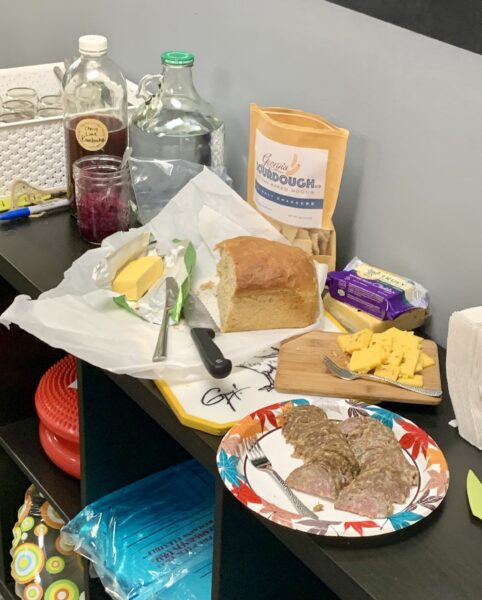
Kate brought a fresh loaf of sourdough to share. We also had a taste of Sandra’s pork salami that she cured from one of Kate’s harvested hogs, as well as a local cheese. Marina brought her red kraut that she fermented for months and Georgia’s Sourdough Crackers!

Filed Under: Past Meetings

Sauerkraut from Nourishing Traditions

April 22, 2024 by northatlantaga 1 Comment

This is the recipe we followed at our April 2024 Meeting about fermented vegetables.

Makes 1 quart

  • 1 quart-sized wide-mouth mason jar with lid and band
  • 1 medium cabbage, cored and shredded (reserve one large leaf to use as a the top layer)
  • 1 tablespoon caraway seeds
  • 1 tablespoon sea salt
  • 4 tablespoons whey (if not available, use an additional 1 tablespoon of salt)

In a bowl, mix shredded cabbage with caraway seeds, sea salt and whey. Pound with a wooden pounder or meat hammer for about 10 minutes to release juices. Place in a quart-sized, wide-mouth mason jar and press down firmly with a pounder or meat hammer until juices come to the top of the cabbage. The top of the cabbage should be at least 1 inch below the top of the jar. Stuff the large cabbage leaf you saved into the top of the jar to keep everything else below the bring. Cover loosely with canning lid and keep at room temperature for about 3 days before transferring to the refrigerator. The sauerkraut may be eaten immediately, but it improves with age.

Optional Additions:

Add any combination of shredded carrot, mustard seeds, dill, garlic powder, etc. to add new and interesting flavors to your sauerkraut.

Filed Under: Recipes

April 2024 Meeting

April 10, 2024 by northatlantaga 2 Comments

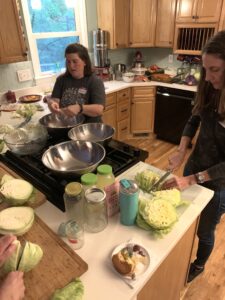
At our April meeting we started with a quick tour of Sandra’s garden. Back inside, we talked about the history and benefits of lacto-fermented food. We sampled a variety of fermented vegetable. Then everyone made their own jar of sauerkraut to take home. Here is the recipe we followed:
Sauerkraut from Nourishing Traditions

In a recent Wise Traditions Podcast they also talked about gut health and the importance of using whole food probiotics for overall health.
Wise Traditions Podcast Episode #471
Address Gut Distress with Dr. Loredana Shapson

Sandra’s notes from her presentation on Fermented Foods:

I’m sure you have all heard of Probiotics.

  • Today, most of us have heard we are supposed to get plenty of probiotics after a round of antibiotics to get things
  • When you’re done with your antibiotics then you can stop with the probiotics and everything goes back to normal. Right? WRONG!

Our culture is terrified of germs and obsessed with hygiene

  • chlorinated water
  • antibacterial soap
  • hand sanitizer
  • worst of all: we pasteurize and sterilize our food – if the lid doesn’t pop we don’t eat it.

What did humans do before all of this life-saving food technology?

  • Canning was only invented in 1810
  • 1812 the first U.S. canning facility for oysters, meats, fruits and vegetables opened in New York
  • Mass production of modern refrigerators didn’t get started until after World War II (1946)
  • 1955 80% of American homes now have refrigerators

Fruits and vegetables don’t grow all year long. The farther away you get from the equator the shorter your growing season. You have to have some way to preserve food for the winter time.

For thousands of years humans have used a process called lacto-fermentation to preserve food.

Every culture around the world has some form of traditional fermented food.

Cabbage most common

  • In China, records date that cabbage has been fermented for over 6,000 years.
  • historical Roman texts, sauerkraut was prized for its delicious taste and medicinal properties.
  • British explorer, Captain James Cook, forced his crew to eat sauerkraut (1768 to 1780).
  • Russia and Poland use pickled green tomatoes, peppers and lettuces.
  • Korean kimchi, for example, is a lacto-fermented condiment of cabbage with other vegetables and seasonings and is eaten daily.
  • In Japan, it’s not a complete meal without miso, soy sauce and pickles.
  • India soured milk is consumed at practically every meal.
  • Africa porridge of fermented millet, corn, cassava, and sorghum are daily staples.
  • Muslim countries – fermented-grain breads and milk products.
  • Early American tradition includes many types of relishes, developed primarily to mask the taste and odor of less than fresh food. In India, varieties of chutneys, all of which were originally lacto-fermented products, are traditional foods.

Only recently have canning and freezing emerged as alternative methods of long term food preservation. They are convenient in some respects, but nutritionally speaking, they are a step backwards from fermentation.

Pasteurization and canning are the opposite of Lacto-fermentation

In Fermentation you are setting up a proper environment to encouraging the growth of beneficial bacteria, mostly lactobacillus.

  • Lactobacillus feed on the sugars present in foods to create lactic acid that suppresses the toxin producing bacteria – preserving the food.
  • Microorganisms in the fermentation process also produce vitamins, enzymes, antioxidants, beta-glucans, and phytonutrients.

We nourish ourselves not by what we eat but by what we are capable of breaking down and transforming into nutrients the body can use.

The digestive process has two distinct features:

  • one is the breaking down of ingested foods;
  • the other is the building up of nutrients needed by the body.

If the breaking down is incomplete, the building up cannot proceed correctly.

Lactic acid contributes to both processes – that of decomposition and that of reconstruction.

  • LA Supplies digestive juices in the form of organic acids that help break down the foods we eat,
  • Activates the metabolic processes whereby these foods are transformed into new living substances.

Lactic acid normalize the acidity of the stomach.

  • If stomach acidity is insufficient, it stimulates the acid producing glands of the stomach
  • In cases where acidity is too high it has the inverse effect.

Lactic acid helps break down proteins and thus aids in their assimilation of iron.

  • The decomposition in the stomach of the organic forms of iron depends on the quantity of hydrochloric acid present as well as the amount of vitamin C

Lactic acid activates the secretions of the pancreas, which is particularly important for diabetics

A 1999 study published in the Lancet found that consumption of lacto-fermented vegetables was positively associated with low rates of asthma, skin problems and autoimmune disorders in Swedish children attending a Waldorf school. The same study found that use of raw milk and avoidance of vaccinations added to the protective effects.

VEGGIES

ANY vegetable can be fermented. Feel free to experiment!

Today we are making Sauerkraut from Nourishing Traditions: In addition to all the benefits of lactic acid, sauerkraut contains large quantities of choline

  • lowers blood pressure and regulates the passage of nutrients into the blood
  • aids the body in the metabolism of fats. If choline is lacking, fats accumulate in the liver

Sauerkraut also contains acetylcholine which has a powerful effect on the parasympathetic nervous system.

  • helps reduce blood pressure
  • slows down the rate of heartbeat
  • promotes calmness and sleep.
  • beneficial effect on the peristaltic movements of the intestine. Sauerkraut and other lacto-fermented vegetables thus are recommended for constipation.

According to a Finnish study, published in the Journal of Agricultural and Food Chemistry, fermentation breaks down glucosinolates in cabbage into compounds called isothiocyanates, which are already known to fight cancer. We are finding that fermented cabbage could be healthier than raw or cooked cabbage,” says one of the paper’s authors.

DRINKS

Beet Kvass is valuable for its medicinal qualities and as a digestive aid.

We talked about beets and beet Kvass at our last meeting: March 2024 Meeting

One glass morning and night

  • is an excellent blood tonic,
  • promotes regularity,
  • aids digestion,
  • alkalizes the blood,
  • cleanses the liver and is a
  • good treatment for kidney stones and other ailments.

Beet kvass may also be used in place of vinegar in salad dressings and as an addition to soups.

Kombucha

  • Mother, mushroom, SCOBY
  • Said to help controll excess Candida.
  • May contain probiotic strain S. Boulardii

DAIRY

Yogurt, Kefir, Cultured Butter
Before the age of industrialization, milk was consumed as yogurt, cheese, clabber, or curds and whey.
Without pasteurization or refrigeration, milk sours and separates spontaneously.

This is due to the process of lacto-fermentation

  • lactic-acid-producing bacteria begin digesting or breaking down both milk sugar (lactose) and milk protein (casein).

When these friendly bacteria have produced enough lactic acid to inactivate all putrefying bacteria, the milk is preserved from spoilage for several days or weeks. In the case of cheese, for years.

Research has shown that regular consumption of cultured dairy products lowers cholesterol and protects against bone loss.

Both vitamin B and vitamin C content of milk increase during fermentation.

Fermentation also breaks down casein, or milk protein, one of the most difficult proteins to digest.

Culturing restores many of the enzymes destroyed during pasteurization including lactase, which helps the body absorb calcium and other minerals. People who are lactose intolerant can often enjoy cultured dairy products without problems.

GRAINS & SEEDS

While lactic acid fermentation does not usually increase the level of minerals present in fermented foods it does decrease the activity of phytic acid content naturally present in grains.

In the past we ate most of our grains in partially germinated form.

  • Grain standing in sacks in open fields often began to sprout before it was brought into storage.
  • Modern farming techniques prevent grains from germinating before they reach our table.

The process of germination

  • produces Vitamin C
  • increases vitamin B content, especially B2, B5 and B6.
  • Carotene increases dramatically – sometimes 8 fold.
  • neutralizes enzyme inhibitors present in all seeds. These inhibitors can neutralize our own precious enzymes in the digestive tract.

The end result is that you get more bang for your nutritional buck by sprouting or souring the grains & seeds you eat.

Many processed foods available today began as fermented foods, such as ketchup and soft drinks.

Filed Under: Past Meetings

Beet Salad

March 28, 2024 by northatlantaga Leave a Comment

This is the beet salad that Vickie Head made for our March 2024 Meeting on Liver/Gallbladder Flush.

  • 3 cups Red and/or Golden Beets (julienned or shredded)
  • 1 Shallot (sliced) or 1/2 Red Onion (finely minced)
  • 1/2 cup Walnuts (dry-roasted and chopped)
  • Zest of 1 Orange
  • 2 tsp Grainy or Smooth Dijon Mustard
  • 1 T Extra Virgin Olive Oil
  • 2 T Sherry or White Balsamic Vinegar
  • 1 T Orange Juice (freshly squeezed)
  • 2-3 oz Crumbled Goat Cheese
  • To taste, Sea Salt and Freshly Ground Black Pepper
  • To taste, Dill or Parsley (minced)
  1. Trim the beets and reserve cleaned beet greens for another dish.
  2. Peel the beets and cut along with shallots on the julienne blade of a mandolin or grate them using a handheld box or handle grater. You can also use the finely minced red onion in place of the shallots.
  3. In a small dry sauté pan, dry roast the walnuts over medium heat for a couple of minutes, taking care to move the pan around to toss. Toast until fragrant and set aside to cool. Chop after a few minutes.
  4. Place the beets, onions, walnuts and orange zest in a mixing bowl. Add oil, vinegar, orange juice, mustard, salt and pepper. Toss to combine.
  5. Plate your salad in a large bowl (or individual bowls) and top with crumbled goat cheese and dill, parsley or herbs of your choice. Serve and enjoy!

Filed Under: Recipes

March 2024 Meeting

March 28, 2024 by northatlantaga 2 Comments

Wednesday, March 27, 2024 in Sandy Springs

At this meeting we focused on the liver. This organ is a power house in the body. Every single system in a human body is touched by the liver. If your liver is not well, nothing in the body is.

According to Chinese medicine, spring time is the perfect time to clean out that organ. Learn how to keep your gallbladder, and clean out the liver with non-invasive, easy to follow instructions regardless if you have your gallbladder or not.

We started out in the kitchen with tastings of delicious liver supporting foods and drinks, such as beet salad, liver pate, Chanca Piedra tea and beet kvass.

Sandra demonstrated how easy it is to make beet kvass at home. This is the recipe from Nourishing Traditions that she used.

Then we moved to the living room for a liver flush presentation by Marina.

Marina has turned her own health around after a severe gallbladder attack that resulted in a threat of taking out the gallbladder by the doctors. By cleaning out her own liver and gallbladder, she kept her “you don’t really need that organ” (gallbladder), with zero pain, and resulting in more energy and vitality after.

With her knowledge and understanding of how the human body works, Marina’s approach is very effective for anyone that is interested in implementing a regular liver clean out. She has guided hundreds of people on their journey to optimum health with a simple protocol.

View a recording of her liver flush protocol here: {Coming Soon}

Filed Under: Past Meetings

Beet Kvass Recipe from Nourishing Traditions

March 27, 2024 by northatlantaga Leave a Comment

This is the recipe we made at out March 2024 Meeting about the Liver and Gallbaldder

Makes 2 quarts

This drink is valuable for its medicinal qualities and as a digestive aid. Beets are just loaded with nutrients. One 4-ounce glass, morning and night, is an excellent blood tonic, promotes regularity, aids digestion, alkalizes the blood, cleanses the liver and is a good treatment for kidney stones and other ailments. Beet kvass may also be used in place of vinegar in salad dressings and as an addition to soups.
~ Sally Fallon, Nourishing Traditions

Ingredients:

  • 3 medium or 2 large organic beets, peeled and chopped coarsely
  • 1/4 cup whey (or liquid from a previous batch)
  • 1 tablespoon sea salt
  • filtered water

Place beets, whey, and salt in a 2-quart glass container (or divide into 2 quart-size mason jars). Add filtered water to fill the container. Stir well and cover securely. Keep at room temperature for 2 daus before transferring to refrigerator.

When most of the liquid has been drunk, you may fill up the container with water and keep at room temperature another 2 days. The resulting brew will be slightly less strong than the first. After the second brew, discard the beets and start again. You may, however, reserve some of the liquid and use that as your inoculant instead of the whey.

Note: Do not use grated beets in the preparation of beet tonic. When grated, beets exude too much juice resulting in a too rapid fermentation that favors the production of alcohol rather than lactic acid.

Filed Under: Recipes

February 2024 Meeting

February 29, 2024 by northatlantaga 1 Comment

Gardening

Our February meeting demystified gardening with tools and tips on how to grow our own food whether we have a few pots on a patio or half an acre to use.

Sandra presented the topic of growing your own food, both vegetables and animals. She raises chickens, rabbits, fruits, and vegetables on her ½ acre.

In addition to gardening, Sandra shared her favorite Easy Sourdough Dinner Roll Recipe and demonstrated how to make them. Of course we ate them slathered with lots of butter!

We also placed a collective group order ahead of time, for onion plantings. Anyone who placed an order, picked up ready to plant onions at the meeting.

Sandra’s PowerPoint Presentation about Gardening

Filed Under: Past Meetings

  • « Go to Previous Page
  • Page 1
  • Page 2
  • Page 3
  • Page 4
  • Page 5
  • Go to Next Page »

Primary Sidebar

Archives

  • March 2026
  • January 2026
  • December 2025
  • November 2025
  • October 2025
  • September 2025
  • August 2025
  • July 2025
  • June 2025
  • May 2025
  • April 2025
  • March 2025
  • February 2025
  • January 2025
  • November 2024
  • October 2024
  • September 2024
  • August 2024
  • July 2024
  • June 2024
  • May 2024
  • April 2024
  • March 2024
  • February 2024
  • January 2024

External Links


Weston A. Price Foundation

Legal Defense Fund